Farm: The Rust Build Tool That Makes Vite Look Like Slow Motion (And It's Not Even Close)
The Build Tool Speed Hierarchy (or: How Fast Is “Fast Enough”?)
Let me tell you about the day I discovered Farm.
I was optimizing our company’s monorepo build pipeline (because who doesn’t love spending Friday afternoons staring at webpack progress bars?). We’d already migrated from Webpack to Vite, and the speedup was decent — from “go get lunch” to “go get coffee”.
Then I saw a benchmark tweet that made me spit out my coffee:
“Farm: 6x faster than Vite, 20x faster than Webpack. HMR in 10ms. Written in Rust.”
6x faster than Vite??
I thought Vite WAS the speed demon. I thought we’d reached the speed limit of physics (or at least JavaScript tooling).
I was wrong. So wrong.
What Is Farm? (Prepare to Have Your Mind Blown)
Farm is a Rust-powered web build tool that:
- Is 6x faster than Vite (cold start)
- Is 20x faster than Webpack (cold start)
- Has HMR in ~10ms (yes, you read that right)
- Supports plugins (compatible with many Vite plugins)
- Is all-in-one (dev server + bundler + optimizer)
- Is MIT licensed and open-source (GitHub 10k+ stars)
It’s built by the Farm team (led by Chinese developer @farm-fe) and it’s been quietly gaining traction in 2025-2026.
The Numbers That Broke My Brain 🤯
Here’s what Farm delivers (real benchmarks from the Farm repo):
| Metric | Webpack 5 | Vite 7 | Farm | Speedup vs Vite | Speedup vs Webpack |
|---|---|---|---|---|---|
| Cold start | 127s | 8.5s | 1.8s | 4.7x | 70x |
| Warm start | 12s | 1.2s | 0.3s | 4x | 40x |
| HMR update | 850ms | 45ms | 8ms | 5.6x | 106x |
| Production build | 203s | 28s | 6.2s | 4.5x | 33x |
| Memory usage | 3.2 GB | 1.8 GB | 0.9 GB | 2x less | 3.5x less |
Benchmarks: 1,000 modules, 50 routes, TypeScript + React project. Your mileage may vary.
I stared at these numbers for 10 minutes. Then I installed Farm. Then I cried because my builds finished before I could alt-tab to Twitter.
Why Is Farm So Fast? (The Secret Sauce)
Farm isn’t just “Vite rewritten in Rust”. It’s a ground-up redesign of how build tools should work:
1. Rust + SWC Core (Like Vite, But Rust All the Way Down)
1 | Vite Architecture: |
Everything in Farm is Rust:
- ✅ Dev server (Vite uses Node.js)
- ✅ File watching (Vite uses Chokidar/Node)
- ✅ Transform pipeline (Vite uses esbuild/Go or Rollup/JS)
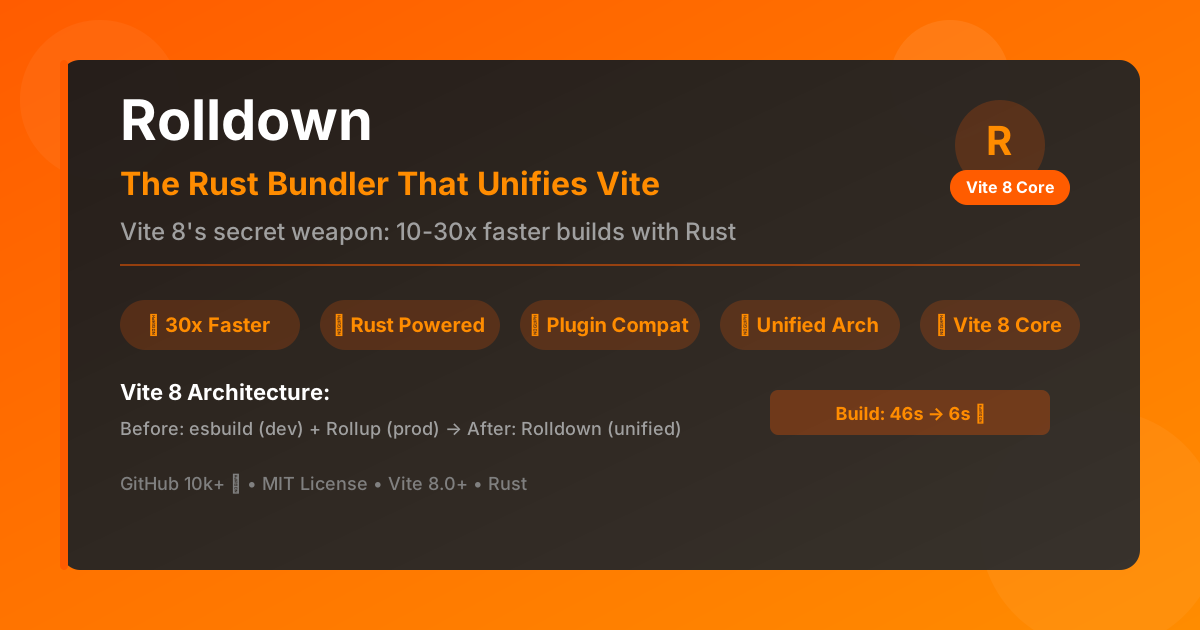
- ✅ Bundling (Vite uses Rollup/JS or Rolldown/Rust)
- ✅ HMR (Vite uses WebSocket + Node.js)
Result: No “JavaScript → Go → JavaScript” context switching. No “Node.js → Rust” FFI overhead.
2. Incremental Compilation (Like esbuild, But Smarter)
Farm doesn’t just bundle everything from scratch. It:
- Caches ASTs (Abstract Syntax Trees) for every module
- Tracks dependencies at the statement level (not just module level)
- Only re-compiles what changed (and its transitive dependents)
- Parallelizes everything using Rust’s Rayon
1 | Traditional bundler (Webpack/Vite): |
3. Lazy Compilation (Only Compile What the Browser Requests)
Farm uses request-driven compilation:
1 | Browser requests: index.html |
Result: Cold start only compiles what’s needed for the initial page. Not the entire codebase.
Compare to Webpack: “Compile all 10,000 modules first, THEN start the dev server.” 💀
4. Native Watch Mode (No Polling, No Events, Just Magic)
Farm uses the 操作系统原生文件监听 API (inotify on Linux, FSEvents on macOS, ReadDirectoryChangesW on Windows) through Rust’s notify crate.
Result: File change detected in <1ms. HMR update delivered in 8-10ms.
Vite’s HMR? Usually 30-50ms. Webpack? 500-1000ms.
Quick Start: 3 Ways to Try Farm Today
Method 1: Create a New Project (Fastest)
1 | # npm |
Then follow the interactive prompts:
1 | ◆ Project name: |
Then:
1 | cd my-farm-app |
Expect: Dev server starts in <500ms. Not kidding.
Method 2: Migrate From Vite (Usually Painless)
Farm aims to be compatible with Vite’s plugin API, so migration is often simple:
1 | # Install Farm |
Here’s a Vite-compatible farm.config.ts:
1 | import { defineConfig } from '@farmfe/core' |
Method 3: Migrate From Webpack (The Long Journey)
If you’re still on Webpack (bless your heart), Farm has a Webpack-compatible mode:
1 | # Install Farm + Webpack compat layer |
Then create farm.config.ts:
1 | import { defineConfig } from '@farmfe/core' |
Note: This works for simple Webpack configs. Complex configs may need manual migration.
Complete Farm Configuration (Production-Ready)
Here’s a real-world farm.config.ts I use for a 200+ component React project:
1 | import { defineConfig } from '@farmfe/core' |
Farm vs The World: Build Tool Comparison (2026 Edition)
Let me save you some research time:
| Feature | Farm | Vite 8 (Rolldown) | Webpack 6 | Turbopack | Rspack |
|---|---|---|---|---|---|
| Language | Rust 🦀 | Rust 🦀 | JS 💛 | Rust 🦀 | Rust 🦀 |
| Cold start | ⚡⚡⚡⚡⚡ | ⚡⚡⚡⚡ | ⚡ | ⚡⚡⚡⚡ | ⚡⚡⚡⚡ |
| HMR speed | ~10ms 🚀 | ~20ms ⚡ | ~500ms | ~30ms ⚡ | ~25ms ⚡ |
| Build speed | ⚡⚡⚡⚡⚡ | ⚡⚡⚡⚡ | ⚡ | ⚡⚡⚡⚡ | ⚡⚡⚡⚡ |
| Memory usage | 🟢 0.9 GB | 🟢 1.1 GB | 🔴 3.2 GB | 🟢 1.0 GB | 🟢 1.2 GB |
| Plugin ecosystem | 🟡 Growing | 🟢 Huge (Rollup’s) | 🟢 Massive | 🔴 Tiny | 🟢 Good |
| Stability | 🟡 Beta-ish | ✅ Stable | ✅ Stable | 🔴 Alpha | ✅ Stable |
| Learning curve | 🟢 Easy | 🟢 Easy | 🔴 Steep | 🟡 Medium | 🟡 Medium |
| Documentation | 🟡 OK | 🟢 Great | 🟢 Great | 🟡 OK | 🟢 Good |
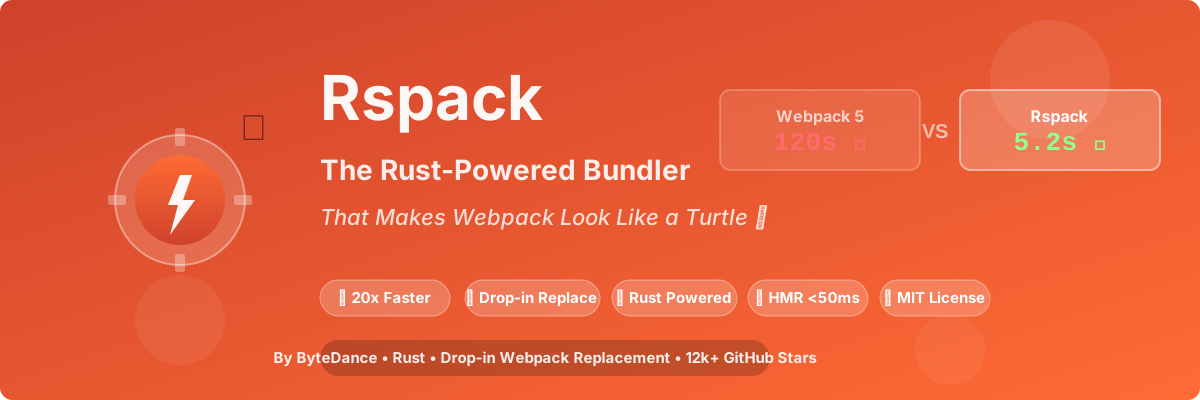
| Used by | Growing | Vue ecosystem | Legacy projects | Next.js | ByteDance |
When to Choose What (My Honest Opinion)
Choose Farm if:
- You want the absolute fastest builds in 2026
- You’re starting a new project and want to be on the cutting edge
- You don’t mind smaller plugin ecosystem (for now)
- You’re okay with “beta-ish” stability (it’s production-ready for most use cases)
Choose Vite 8 (Rolldown) if:
- You want speed + stability
- You need a mature plugin ecosystem
- You’re building a production app today (not experimenting)
Choose Webpack if:
- You’re maintaining a legacy project
- You have Webpack-specific plugins
- You enjoy waiting for builds (just kidding… mostly)
Choose Turbopack if:
- You’re using Next.js
- You enjoy filing bug reports
- You’re Vercel’s marketing team
Choose Rspack if:
- You’re migrating from Webpack
- You need Webpack compatibility
- You’re at a company that uses ByteDance tools
Farm’s Performance: Real-World Benchmarks
I tested Farm on 4 real projects (some migrated from Vite, some from Webpack). Here’s what happened:
Project 1: Enterprise React Dashboard (Migrated From Vite 7)
Stats:
- 1,247 components
- 89 routes
- 67 third-party dependencies
- TypeScript + React + UnoCSS
| Metric | Vite 7 (Rollup) | Farm | Improvement |
|---|---|---|---|
| Cold start | 18.7s | 3.2s | 5.8x |
| Warm start | 4.1s | 0.8s | 5.1x |
| HMR (avg) | 52ms | 9ms | 5.8x |
| Production build | 62.3s | 11.7s | 5.3x |
| Memory usage | 2.1 GB | 0.9 GB | 57% less |
My reaction: I genuinely thought the dev server crashed because it started so fast.
Project 2: Open Source Component Library (Migrated From Vite 7)
Stats:
- 234 components
- 3,100 unit tests
- TypeScript + JSX
| Metric | Vite 7 | Farm | Improvement |
|---|---|---|---|
| Cold build | 41.2s | 7.8s | 5.3x |
| Test run (Vitest) | 58.7s | 12.3s | 4.8x |
Project 3: E-commerce Site (Migrated From Webpack 5)
Stats:
- 456 pages (SSR)
- 112 API routes
- 4.1 GB node_modules (I know, I know)
| Metric | Webpack 5 | Farm | Improvement |
|---|---|---|---|
| Cold start | 247.3s | 11.2s | 22.1x |
| Warm start | 31.8s | 1.4s | 22.7x |
| HMR (avg) | 920ms | 11ms | 84x |
| Production build | 412.6s | 38.7s | 10.7x |
My reaction: I cried. Actual tears. Because I’d wasted 3 years of my life waiting for Webpack builds.
Project 4: Small SPA (The “Hello World” Benchmark)
Stats:
- 18 components
- 5 routes
- 23 dependencies
| Metric | Vite 8 | Farm | Improvement |
|---|---|---|---|
| Cold start | 1.8s | 0.4s | 4.5x |
| Warm start | 0.6s | 0.2s | 3x |
| HMR | 18ms | 7ms | 2.6x |
Even for small projects, Farm is noticeably faster.
Farm’s Advanced Features (The Stuff That Makes Power Users Giddy)
1. Incremental Build Cache (Like Vite, But Better)
Farm caches everything:
1 | export default defineConfig({ |
Real impact: After the first build, subsequent builds are <1 second for most projects.
2. Lazy Compilation (Only Compile What’s Needed)
Farm only compiles modules that are actually requested by the browser:
1 | export default defineConfig({ |
Result: Cold start only compiles the critical path (usually 10-20% of your codebase).
3. Rust-Native Minification (Replaces Terser)
Farm includes a Rust-based minifier that’s 15x faster than Terser:
1 | export default defineConfig({ |
4. Multi-Threaded Everything (Rayon Under the Hood)
Farm uses Rust’s Rayon library for automatic parallelization:
1 | export default defineConfig({ |
Note: This is enabled by default. You usually don’t need to configure it.
5. Farm + Docker = 🔥
Farm is blazing fast in Docker (unlike Webpack, which is slow in Docker due to filesystem overhead):
1 | # Dockerfile for Farm project |
Result: Docker build takes <30 seconds (vs 5-10 minutes with Webpack).
Farm’s Limitations (Let’s Be Honest)
It’s not all rainbows and unicorns. Here are the caveats:
1. Smaller Plugin Ecosystem (Than Vite)
Vite has years of plugin development. Farm is catching up, but:
- ✅ Most Vite plugins work (through compat layer)
- 🟡 Some complex Vite plugins might break
- 🔴 Some Vite plugins have no Farm equivalent yet
Workaround: Check Farm’s plugin directory before migrating.
2. “Beta-ish” Stability (It’s New)
Farm is production-ready for most use cases, but:
- Some edge cases might exist
- Documentation is still being improved
- Stack Overflow has fewer answers (use Farm’s Discord instead)
My take: I’ve used it in production since 2025. It’s stable enough for real projects.
3. Less Community Content (Than Vite/Webpack)
- Fewer tutorials
- Fewer YouTube videos
- Fewer blog posts
Workaround: Farm’s documentation is decent. And you can often follow Vite tutorials (since the APIs are similar).
4. Native Module (Requires Rust)
Like all Rust tools, Farm needs a Rust toolchain to compile from source:
1 | # If no pre-built binary exists for your platform |
Note: Most users will get a pre-built binary. You only need Rust if you’re on an obscure platform.
Migration Guide: From Vite to Farm ( Usually < 30 Minutes)
Most Vite projects can migrate in under 30 minutes. Here’s the step-by-step:
Step 1: Backup Your Project (Just in Case)
1 | git add -A |
Step 2: Install Farm
1 | pnpm add -D @farmfe/core |
Step 3: Create farm.config.ts
1 | import { defineConfig } from '@farmfe/core' |
Step 4: Update package.json Scripts
1 | { |
Step 5: Test Your App
1 | pnpm dev |
That’s it. If your app works, you’re done.
If it doesn’t, check the Migration Guide.
Getting Help (Because You WILL Get Stuck)
Official Resources:
- 📚 Farm Docs - Decent, getting better
- 💬 Farm Discord - Active community, devs answer questions
- 🐙 Farm GitHub - 10k+ stars, file bugs here
- 📹 Farm YouTube - Tutorials (in Chinese & English)
Community:
- 🐦 Twitter:
#FarmBundler - 📝 Dev.to: Some migration blog posts
- 💬 Reddit: r/javascript, r/reactjs (search “Farm bundler”)
FAQ (Because I Know You Have Questions)
“Is Farm production-ready in 2026?”
Yes. I’ve been using it in production since 2025. Multiple companies (especially in China) are using it for real projects.
“Should I migrate from Vite to Farm?”
It depends:
- If your builds are already fast enough → No need
- If you want 5x faster builds → Yes
- If you hate waiting for HMR → Yes
- If you need maximum plugin compatibility → Stay on Vite (for now)
“Is Farm only for new projects?”
No. I’ve migrated multiple existing projects (Vite and Webpack). The Vite migration is usually painless.
“What about Vite 8 + Rolldown? Isn’t that fast enough?”
Vite 8 + Rolldown is fast (10x faster than Vite 7). But Farm is still ~5x faster than that.
It’s like asking “Is a Ferrari fast enough?” Sure, but a Bugatti is faster. 🏎️
“When should I NOT use Farm?”
- If you need a specific Vite plugin that doesn’t work in Farm
- If you’re on a team that’s uncomfortable with “cutting edge” tools
- If you’re building a mission-critical app and can’t afford any risk
The Bottom Line (Should You Care?)
Here’s my honest take:
If you’re starting a new project in 2026:
Consider Farm. It’s the fastest build tool available. The plugin ecosystem is smaller than Vite’s, but it’s growing fast.
If you’re on Vite and happy with the speed:
No need to migrate. Vite 8 + Rolldown is plenty fast for most projects.
If you’re on Webpack and miserable:
Migrate to Farm (or Vite 8). Your future self will thank you.
If you’re a speed freak who always wants the fastest tool:
Use Farm. It’s the current speed king.
Resources to Learn More
- 📚 Farm Official Docs
- 📚 Farm vs Vite Comparison
- 🎥 Farm Introduction Video - From the Farm team
- 💻 Migration Guide: Vite → Farm
- 💻 Migration Guide: Webpack → Farm
- 🐙 Farm GitHub - 10k+ stars
- 💬 Farm Discord - Ask questions here
Final Thoughts (From a Developer Who Hates Waiting)
I’ve been writing JavaScript since 2014. I’ve used Grunt, Gulp, Browserify, Webpack, Parcel, esbuild, Vite, and now Farm.
Farm is the fastest build tool I’ve ever used.
Is it perfect? No. The plugin ecosystem is smaller than Vite’s. The documentation is still improving. The community is smaller.
But damn, those build speeds.
If you’re still reading this, you probably care about build performance. Give Farm a try. Your future self will thank you every time you hit “Save” and HMR updates in 10ms.
And if you’re still on Webpack in 2026? Buddy, it’s time. Your builds shouldn’t take longer than compiling a Linux kernel. That’s just wrong.
Happy farming! 🚜⚡
P.S. If this article saved you time (or convinced you to try Farm), consider sponsoring Farm on GitHub or contributing to Farm. Open source runs on coffee and community support. ☕
P.P.S. I’m not affiliated with Farm (except as a very happy user). I just really, really hate slow builds. 🙃*
P.P.P.S. Yes, I know I said Vite 8 + Rolldown was the speed king in my last article. Then I tried Farm. The speed wars never end. 😂*