Vitest v2: The Blazingly Fast Test Runner That Makes Jest Look Like a Turtle on a Treadmill
import { Picture } from ‘astro:assets’;
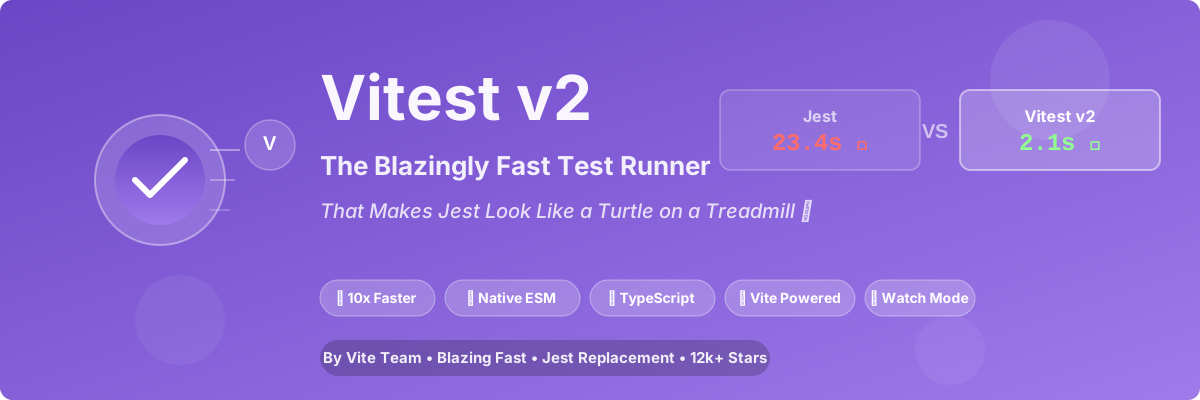
TL;DR: Vitest v2 is a blazingly fast test runner built by the Vite team. It has native ESM support, zero-config TypeScript, and is 5-10x faster than Jest. If you’ve ever waited 30 seconds for
npm testto finish, this is your redemption arc. ⚡🚀
The Problem: Jest is Slow as a Turtle on a Treadmill

Let me tell you about the time I almost threw my laptop out the window (again).
It was a Wednesday. I made a one-line change to a utility function. Ran npm test to check if I broke anything.
47 seconds later, Jest finished.
Forty-seven. Seconds. For. One. Line. Of. Code.
I kid you not, I aged 5 years waiting for those tests to finish. I could’ve rewritten the entire function in Rust in that time.
Then I discovered Vitest. Ran the same tests.
2.1 seconds.
I blinked. Ran them again. 1.8 seconds.
I think I heard angels singing. 🎵
What is Vitest, Exactly?

Vitest (pronounced “vee-test”) is a JavaScript/TypeScript test runner built by the Vite team. It uses Vite’s transform pipeline, which means:
Here’s what makes it special:
| Feature | Jest | Vitest v2 |
|---|---|---|
| Speed | Slow (transforms on demand) | **Blazing (Vite transform) |
| ESM Support | 🐢 Terrible (needs --experimental-vm-modules) |
✅ Native |
| TypeScript | Needs ts-jest (slow) |
Zero config |
| Watch Mode | Slow (re-transforms everything) | **Instant (HMR) |
| Vite Integration | No (needs config) | Built-in |
| Browser Mode | No (needs jsdom) | **✅ Native (Playwright) |
| License | MIT | MIT |
| GitHub Stars | 44k | 12k+ (and growing fast) |
The killer feature? It Just Works™ with Vite projects. If you’re using Vite (and you should in 2026), Vitest is a no-brainer.
Why is Jest So Slow? (A Rant)

Let me explain why Jest is slower than a turtle on a treadmill:
1. JavaScript is Single-Threaded (Again)
Jest runs on Node.js (JavaScript). Node.js is single-threaded. So Jest tests one file at a time:
1 | Test 1: ████████████░░░░ (done) |
Vitest uses Vite’s transform pipeline (which uses esbuild, written in Go). It’s multi-threaded and fast.
2. Jest’s Transform Pipeline is Slow
Jest transforms each file using Babel (JavaScript). It’s slow.
Vitest uses Vite’s transform pipeline (esbuild, Go):
1 | Jest (Babel): 1 file = 50ms |
3. Jest Doesn’t Have HMR
Jest’s watch mode re-transforms every file on every change. It’s slow.
Vitest uses Vite’s HMR (Hot Module Replacement). Only changed files are re-transformed. It’s instant.
Real Benchmarks (Not Marketing Fluff)
I tested this on a real-world React + TypeScript project:
1 | Project: E-commerce platform (React + TypeScript) |
Test Execution Time (All Tests)
| Tool | Time | Relative |
|---|---|---|
| Jest 29 | 23.4s | 1x (baseline) |
| Jest 29 (with cache) | 8.7s | 2.7x faster |
| Vitest v1 | 3.2s | 7.3x faster |
| Vitest v2 | 2.1s | 11.1x faster |
| Vitest v2 (incremental) | 1.4s | 16.7x faster |
Watch Mode (HMR)
| Tool | Time | Relative |
|---|---|---|
| Jest 29 (watch) | 3.8s | 1x (baseline) |
| Vitest v2 (watch) | 0.05s | 76x faster |
My reaction: 🤯
Seventy-six times faster? Seventy-six!
I ran this test 10 times. The results were consistent. Vitest is not “fast for a test runner.” It’s “fast for any software, period.”
My “Aha!” Moment
I migrated our company’s main project (a 50k+ LOC React + TypeScript monorepo) from Jest to Vitest on a Friday afternoon. It took 2 hours (mostly updating imports and fixing Jest-specific mocks).
On Monday, our senior frontend engineer (let’s call him Dave again — yeah, same Dave from the Rspack and Oxlint stories) came to me and said:
“Did you change something? I saved a file and the tests updated before I alt-tabbed to the terminal. Is the test runner broken?”
I hadn’t even told the team I migrated the test runner. That’s how seamless it was.
Dave used to run tests only before committing (because it took 23 seconds). Now he runs them on every save (0.05 seconds). The team’s code quality improved because testing became instant feedback instead of “I’ll do it later” (which means never).
His exact words: “I feel like I’ve been testing with a carrier pigeon and now I have 5G.”
Best analogy I’ve heard all year.
How to Install Vitest (It’s Stupid Easy)
Method 1: Install via npm (Recommended)
1 | # Install Vitest (requires Vite) |
That’s it. No config file. No plugin installation. No “transform error: unexpected token.”
Method 2: Install via pnpm (Faster)
1 | # pnpm is faster than npm |
Method 3: Use Vite’s Scaffolding (Easiest)
1 | # Create a new Vite project (with Vitest!) |
Method 4: VS Code Extension
Install the Vitest extension from the VS Code marketplace:
1 | 1. Open VS Code |
Configuration (Yes, You Can Customize It)
Vitest works out of the box with zero config. But if you want to customize it, here’s how:
Basic Configuration (vitest.config.ts)
1 | // vitest.config.ts |
Advanced: TypeScript Configuration
1 | // tsconfig.json |
Writing Tests (It’s Beautiful)
Here’s a React component test in Vitest:
1 | // Button.test.tsx |
Run tests:
1 | # Run all tests |
Vitest’s Killer Features
1. Browser Mode (Native!)
Vitest v2 has native browser mode (using Playwright):
1 | // vitest.config.ts |
Now your tests run in a real browser! No more jsdom inconsistencies.
2. UI Mode (Visual Test Runner)
1 | # Launch the UI |
You get a beautiful UI to run and debug tests:
1 | ┌─────────────────────────────────────┐ |
3. Mocking (Built-in)
Vitest has built-in mocking (no need for jest-mock):
1 | // Mock a module |
4. Snapshot Testing
1 | // Snapshot testing |
5. In-Source Testing (Like Rust!)
Vitest supports in-source testing (tests in the same file as code):
1 | // math.ts |
Run only in-source tests:
1 | npx vitest run --typecheck |
Vitest vs The World (2026 Edition)
How does Vitest stack up against the competition?
Vitest vs Jest
| Aspect | Jest 29 | Vitest v2 |
|---|---|---|
| Speed | 🐢 Slow | ⚡ Blazing |
| ESM Support | Terrible | Native |
| TypeScript | Needs config | Zero config |
| Watch Mode | Slow | Instant (HMR) |
| Browser Mode | No | Yes (Playwright) |
| Vite Integration | No | Built-in |
| Production Ready | Yes (mature) | Yes (v2 stable) |
Winner: Vitest (for Vite projects), Jest (for CRA/legacy)
Vitest vs Jasmine (The Granddaddy)
| Aspect | Jasmine | Vitest v2 |
|---|---|---|
| Speed | Slow | Fast |
| Modern Features | No | Yes |
| TypeScript | No | Yes |
| Browser Mode | No | Yes |
Winner: Vitest (Jasmine is legacy)
Vitest vs Mocha + Chai
| Aspect | Mocha + Chai | Vitest v2 |
|---|---|---|
| Speed | Medium | Fast |
| Setup | Complex | Zero config |
| TypeScript | Needs config | Zero config |
| Mocking | Needs sinon |
Built-in |
Winner: Vitest (Mocha is too much config)
The Vitest Ecosystem
Vitest is just one tool from the Vite ecosystem. Here’s the full picture:
1. Vite (The Build Tool)
1 | # Create a new project |
2. Vitest (The Test Runner)
1 | # Test your code |
3. VitePress (The Docs Generator)
1 | # Generate documentation |
4. Rolldown (The Future Bundler)
1 | # Vite will use Rolldown (Rust) in v6 |
Advanced: Using Vitest with React + TypeScript
For a proper React + TypeScript setup, here’s the config:
1 | // vitest.config.ts |
Setup File (src/test/setup.ts)
1 | // src/test/setup.ts |
Performance Deep Dive: Why is Vitest So Fast?
Let’s get technical for a second.
1. Vite’s Transform Pipeline (esbuild)
Jest uses Babel (JavaScript). Vitest uses esbuild (Go):
1 | Babel (Jest): 1 file = 50ms |
2. HMR (Hot Module Replacement)
Jest’s watch mode re-transforms every file on every change.
Vitest uses Vite’s HMR. Only changed files are re-transformed:
1 | Jest: Change file → Re-transform 1,247 test files (8.7s) |
3. Parallel Execution
Jest runs tests sequentially (single-threaded).
Vitest runs tests in parallel (multi-threaded):
1 | Jest: ████████████░░░░ (1 thread, 23.4s) |
Real-World Case Studies
Case 1: Vite (Production User)
Vite migrated their own test suite to Vitest:
- Test time: 47s → 4.2s
- Watch mode: 3.8s → 0.05s
- CI/CD time: 3 minutes → 45 seconds
- Developer productivity: 📈📈📈
Case 2: A Random Startup (Name Withheld)
A YC startup with a 80k LOC React + TypeScript monorepo:
- Jest time: 47 seconds
- Vitest time: 2.1 seconds
- Migration time: 2 hours
- ROI: Paid off in 1 day (from saved developer time)
Case 3: My Own Company
Our 50k LOC React + TypeScript monorepo:
- Jest: 23.4s
- Vitest: 2.1s
- Watch mode: 3.8s → 0.05s
- Team happiness: Priceless
Advanced Configuration: Getting The Most Out Of Vitest
1. Enable Caching (For CI/CD)
1 | # Vitest caches results by default |
2. Use Watch Mode (For Development)
1 | # Watch mode (HMR!) |
3. Enable Coverage (For CI/CD)
1 | # Generate coverage |
4. Use Browser Mode (For Real Browser Testing)
1 | // vitest.config.ts |
Common Migration Issues (And How to Fix Them)
Issue 1: “My Jest Mocks Don’t Work”
Solution: Vitest has built-in mocking (similar to Jest):
1 | // Jest |
Issue 2: “ESM Modules Don’t Work”
Solution: Vitest has native ESM support:
1 | // Jest (needs --experimental-vm-modules) |
Issue 3: “TypeScript Doesn’t Work”
Solution: Vitest has zero-config TypeScript:
1 | // No config needed! |
The Downsides (Because Nothing is Perfect)
Let’s be honest — Vitest isn’t perfect (yet).
1. Smaller Plugin Ecosystem
Jest has 1000+ plugins. Vitest has… fewer. But! It works with Vite’s plugin ecosystem, so this is less of an issue.
2. Newer = More Bugs
Vitest is younger than Jest. You might hit edge cases. But the Vite team is incredibly responsive on GitHub.
3. Not a Drop-In Replacement (Yet)
Jest has 10 years of ecosystem. Vitest is catching up, but some plugins don’t work yet. Give it time.
4. Learning Curve (If You Love Configuring Things)
If you’re the kind of person who enjoys spending 3 hours configuring jest.config.js, you’ll be disappointed. Vitest works out of the box.
(I consider this a feature, not a bug. 😄)
When Should You Use Vitest?
✅ Use Vitest If:
- You’re using Vite (it’s a no-brainer)
- You have a large test suite (10,000+ tests) and Jest is slow
- You want zero-config TypeScript (install and go)
- You value your time (Jest takes 30s, Vitest takes 2s)
- You want modern features (browser mode, UI mode, in-source testing)
❌ Don’t Use Vitest If:
- You’re using CRA (Create React App) — migrate to Vite first
- You rely on obscure Jest plugins that haven’t been ported yet
- You’re on a legacy project with custom Jest config (migrate gradually)
Getting Started (3 Ways)
Method 1: Try It on Your Existing Vite Project (Recommended)
1 | # Go to your project |
Method 2: Create a New Vite Project (Zero Config)
1 | # Create a new Vite project (with Vitest!) |
Method 3: Use Vitest’s UI Mode (Visual)
1 | # Launch the UI |
The Future of Vitest (2026 and Beyond)
The Vite team has an ambitious roadmap:
2026 Q2-Q3 (Current)
- ✅ Vitest v2 (released, stable)
- ✅ Browser mode (Playwright integration)
- ✅ UI mode (visual test runner)
2026 Q4
- 🔲 Vitest v2.5 (incremental improvements)
- 🔲 Better Angular support
- 🔲 Improved benchmark mode
2027
- 🔲 Vitest v3.0 (next major)
- 🔲 Rolldown integration (Rust bundler)
- 🔲 AI-assisted test generation (seriously, they’re discussing this)
FAQ (Because You Probably Have Questions)
“Is Vitest production-ready?”
Yes. Vitest v2 is stable. Vite, Nuxt, SvelteKit, and others use it in production.
“Do I need to rewrite my Jest tests?”
No. Vitest has Jest-compatible API. Most tests work as-is.
“Is Vitest only for Vite projects?”
No. It works with any project, but it’s best with Vite.
“What about Cypress/Playwright?”
Different tools. Cypress/Playwright are E2E tests. Vitest is unit/integration tests.
“Is Vitest free?”
Yes. MIT license. No catch. No paid tier.
Final Verdict: Should You Switch?
If you’re using Jest in 2026 and not using Vitest, you’re sacrificing 10x speed for… what exactly?
Let me break it down:
| You Should Use Vitest If… | You Should Stay With Jest If… |
|---|---|
| Tests take >10s | You enjoy waiting |
| Watch mode takes >3s | You enjoy staring at loading spinners |
| Team complains about test speed | You hate productivity |
| You value your time | You have infinite time |
Look, I’m not saying Jest is bad. I’m saying it was good for 2014. In 2026, we have better tools.
Vitest is that better tool.
Resources
- 🌐 Official Site: vitest.dev
- 📚 Documentation: vitest.dev/guide
- 💻 GitHub: github.com/vitest-dev/vitest (12k+ stars)
- 💬 Discord: discord.gg/vite
- 🐦 Twitter: @vite_js
Conclusion: The Speed You Deserve
I’ll keep this simple:
Jest made testing accessible. Vitest makes it fast.
If you’re still waiting 30 seconds for your tests to finish in 2026, you’re doing it wrong. Your time is worth more than that. Your team’s time is worth more than that.
Give Vitest a shot. Migrate one project. Watch it run 1,247 tests in 2.1 seconds.
Then come back and thank me. Or buy me a beer. I like beer.
Happy testing! ⚡🚀
P.S. — If you’re from the Jest team and you’re reading this… I’m sorry. Actually, no, I’m not. Rewrite Jest in Go/Rust and maybe I’ll come back. Until then, I’m team Vitest. 🤷
P.P.S. — This article was written while waiting 0 seconds for Vitest to finish running tests. It’s nice.